The Book of Kings, 1010 AD
Shahnameh شاهنامه
The epic of Ferdowsi, finished in 1010 AD, tells the past of Iran in myth and legend, from the first king to the fall of the Sasanians. Read who wrote it, how little it remembers of the Achaemenids, and its verses in Persian and English.
The poet
Ferdowsi of Tus
Abu’l-Qasem Ferdowsi finished the Shahnameh on 8 March 1010, after more than 30 years of work.
Ferdowsi came from Tus in Khorasan. He was a dehqan, a member of the landed gentry that kept the old stories of Iran.
His main source was a prose Book of Kings, which a team of scholars made in 957 for Abu Mansur, the Samanid governor of Tus. The poet Daqiqi started a verse version but died young. Ferdowsi kept about a thousand of his lines.
Ferdowsi gave the poem to Mahmud of Ghazni. The later writer Nezami Aruzi tells that Mahmud paid him in silver, not in gold. Khaleghi-Motlagh calls many details of this story inaccurate or legendary.
- Born
- About 940 AD, from his own words on his age
- Started
- About 977 AD
- Finished
- 8 March 1010
- Size
- About 50,000 couplets. The count changes with the edition
- Meter
- Motaqareb, eleven syllables in each half line
- Died
- 1020 or 1025. The year is disputed
به نام خداوند جان و خردکزین برتر اندیشه بر نگذرد
خداوند نام و خداوند جایخداوند روزیده رهنمای
خداوند کیوان و گردان سپهرفروزندهٔ ماه و ناهید و مهر
ز نام و نشان و گمان برتر استنگارندهٔ برشده گوهر است
In the name of the Lord of both wisdom and mind, To nothing sublimer can thought be applied, The Lord of whatever is named or assigned A place, the Sustainer of all and the Guide, The Lord of Saturn and the turning sky, Who causeth Venus, Sun, and Moon to shine, Who is above conception, name, or sign, The Artist of the heaven's jewelry!
Show the romanization
be nām-e khodāvand-e jān o kherad / k-az in bartar andishe bar nagzarad
khodāvand-e nām o khodāvand-e jāy / khodāvand-e ruzi-deh-e rahnamāy
khodāvand-e keyvān o gardān-sepehr / foruzande-ye māh o nāhid o mehr
ze nām o neshān o gomān bartar ast / negārande-ye bar-shode gowhar ast
Resources
- Dj. Khaleghi-Motlagh, “Ferdowsi, Abu’l-Qāsem i. Life”, Encyclopaedia IranicaHis name, Tus, the dehqan class, the dates, Mahmud and the story of the payment
- Dj. Khaleghi-Motlagh, “Daqiqi”, Encyclopaedia IranicaDaqiqi and his thousand lines
- “Šāh-nāma”, Encyclopaedia IranicaThe prose Book of Kings of 957 and the year 1010
- J. Perry, “Šāh-nāma v. Arabic Words”, Encyclopaedia IranicaThe motaqareb meter
- Princeton Shahnama ProjectAbout 50,000 couplets
The poem
Four dynasties of kings
The Shahnameh tells the past of Iran, in myth and in legend, as four dynasties, from the first king to the Arab conquest in the 7th century.
The Pishdadians are the first kings of myth: Kayumars, Hushang, Tahmuras, Jamshid, then Fereydun and his heirs. Between Jamshid and Fereydun, the foreign tyrant Zahhak takes the throne. The first kings bring iron, clothes, writing and the crafts to the world.
The Kayanians are kings and heroes. Their great hero is Rostam of Sistan, who is not a king. Their last kings are Bahman, Homay, Darab and Dara.
The Ashkanians, the Parthians, are only a short list of names, except their last king, Ardavan. The Sasanians fill the last part of the poem, until Yazdegerd III and the Arab conquest.
Omidsalar and Daryaee call the Shahnameh literature, not history.
Resources
- A. Sh. Shahbazi, “Historiography ii. Pre-Islamic Period”, Encyclopaedia IranicaThe four dynasties of the Book of Kings
- M. Omidsalar and T. Daryaee, “Šāh-nāma i. The Šāh-nāma as a Historical Source”, Encyclopaedia IranicaThe Ashkanians and Ardavan, and the poem as literature, not history
- M. Omidsalar, “Jamšid ii. In Persian Literature”, Encyclopaedia IranicaZahhak as a foreign ruler who takes the throne
- “Hōšang”, Encyclopaedia IranicaThe first kings and their gifts to the world
- P. O. Skjærvø, “Kayāniān x. The End of the Kayanids”, Encyclopaedia IranicaThe last Kayanian kings, and Rostam as a hero, not a king
Jamshid
The throne in the sky
Jamshid rules for 700 years. He teaches the crafts, and the demons lift his throne into the air on the first day of the year.
Jamshid is king and priest. In steps of fifty years he makes weapons, cloth and the classes of the people. Then he teaches the demons to make bricks, and they build halls and baths for him.
He builds a throne of jewels, and the demons carry it into the sky. The people call that day the new day, the first of Farvardin. Iranian tradition links this day to Nowruz, and Skjærvø thinks that the link is probably older than Islam.
Then Jamshid tells the nobles that he made the world. He loses the farr, the royal glory, and his people turn to Zahhak. After a hundred years Zahhak catches him and saws him in two.
In the Avesta he is Yima, the king of a golden age. The cup of Jamshid is not in the Shahnameh. It probably comes into Persian poetry in the 12th century.
بفرمود دیوان ناپاک رابه آب اندر آمیختن خاک را
هر آنچه از گل آمد چو بشناختندسبک خشت را کالبد ساختند
به سنگ و به گچ دیو دیوار کردنخست از برش هندسی کار کرد
چو گرمابه و کاخهای بلندچو ایوان که باشد پناه از گزند
He bade the foul divs temper earth with water And taught them how to fashion moulds for bricks. They laid foundations first with stones and lime, Then raised thereon by rules of art such structures As hot baths, lofty halls, and sanctuaries.
Show the romanization
befarmud divān-e nāpāk rā / be āb andar āmikhtan khāk rā
har ānche az gel āmad cho beshnākhtand / sabok khesht rā kālbad sākhtand
be sang o be gach div divār kard / nakhost az bar-ash handasi kār kard
cho garmābe o kākh-hā-ye boland / cho eyvān ke bāshad panāh az gazand
Resources
به فرّ کیانی یکی تخت ساختچه مایه بدو گوهر اندر نشاخت
که چون خواستی دیو برداشتیز هامون به گردون برافراشتی
چو خورشید تابان میان هوانشسته برو شاه فرمانروا
جهان انجمن شد بر تخت اوفرومانده از فرّهٔ بخت او
به جمشید بر گوهر افشاندندمر آن روز را روز نو خواندند
سر سال نو هرمز فرودینبرآسوده از رنج تن دل ز کین
... by his royal Grace Made him a throne, with what a wealth of gems Inlaid! which when he willed the divs took up And bare from earth to heaven. There the Shah, Whose word was law, sat sunlike in mid air. The world assembled round his throne in wonder At his resplendent fortune, while on him The people scattered jewels, and bestowed Upon the day the name of New Year's Day, The first of Farwardin and of the year, When limbs repose from labour, hearts from strife.
Show the romanization
be farr-e kayāni yeki takht sākht / che māye bedu gowhar andar neshākht
ke chon khāsti div bar-dāshti / ze hāmun be gardun bar-afrāshti
cho khorshid-e tābān miyān-e havā / neshaste bar-u shāh-e farmān-ravā
jahān anjoman shod bar-e takht-e u / foru-mānde az farre-ye bakht-e u
be jamshid bar gowhar afshāndand / mar ān ruz rā ruz-e now khāndand
sar-e sāl-e now hormoz-e farvadin / bar-āsude az ranj tan, del ze kin
Resources
منی چون بپیوست با کردگارشکست اندر آورد و برگشت کار
چه گفت آن سخنگوی با فرّ و هوشچو خسرو شوی بندگی را بکوش
به یزدان هر آن کس که شد ناسپاسبه دلش اندر آید ز هر سو هراس
به جمشید بر تیرهگون گشت روزهمی کاست زو فرّ گیتیفروز
همی راند از دیده خون در کنارهمی کرد پوزش بر کردگار
همی کاست زو فرّهٔ ایزدیبرآورده بر وی شکوه بدی
... Told of the crime that equalled him with God, Brought on disaster and o'erturned the state. How saith the seer, the man of Grace and wisdom? "King though thou art serve God. Great fears oppress The heart that is devoid of thankfulness." Day darkened to Jamshid, he lost the Grace That lighteneth the world, and though with tears Of blood he sought for pardon Grace was not, And dread of coming evil was his lot.
Show the romanization
mani chon bepeyvast bā kerdgār / shekast andar āvard o bar-gasht kār
che goft ān sokhan-gu-ye bā farr o hush / cho khosrow shavi bandegi rā bekush
be yazdān har ān kas ke shod nā-sepās / be del-ash andar āyad ze har su harās
be jamshid bar tire-gun gasht ruz / hami kāst zu farr-e giti-foruz
hami rānd az dide khun dar kenār / hami kard puzesh bar-e kerdgār
hami kāst zu farre-ye izadi / bar-āvarde bar vey shokuh-e badi
Resources
Resources
- M. Omidsalar, “Jamšid ii. In Persian Literature”, Encyclopaedia IranicaThe 700 years, the steps of fifty years, the bricks, the throne, the fall, the saw and the cup
- P. O. Skjærvø, “Jamšid i. Myth of Jamšid”, Encyclopaedia IranicaYima in the Avesta, his pride, and the link with Nowruz
Takht-e Jamshid
Names on the ruins
Shahbazi writes that later Iranians forgot the name Parsa. They gave the ruins to Jamshid, and called them the throne of Jamshid.
Geographers of the 10th century, such as Masudi and Estakhri, already gave the ruins to Jamshid, before Ferdowsi finished his poem. They also saw Jamshid as Solomon. Some sources give the palaces to the queen Homay.
Other names for the site were Chehel Menar, the forty minarets, and Sad Sotun, the hundred columns. The first use of the name Takht-e Jamshid is not certain.
- Parsa (Persepolis), the palaces of Darius I and his heirs
- Takht-e Jamshid, the throne of Jamshid
- The royal tombs near Parsa
- Naqsh-e Rostam, the pictures of Rostam, after its Sasanian reliefs
- The tomb of Cyrus at Pasargadae
- The tomb of the mother of Solomon
Resources
- A. Sh. Shahbazi, “Persepolis”, Encyclopaedia IranicaThe forgotten name Parsa, Jamshid, Solomon, Homay, Sad Sotun and Chehel Menar
- P. O. Skjærvø, “Jamšid i. Myth of Jamšid”, Encyclopaedia IranicaThe date of the name Takht-e Jamshid is not known
- H. von Gall, “Naqš-e Rostam”, Encyclopaedia IranicaThe name Naqsh-e Rostam and its Sasanian reliefs
- D. Stronach and H. Gopnik, “Pasargadae”, Encyclopaedia IranicaThe tomb of the mother of Solomon
The lost kings
Where are Cyrus and Darius?
The Shahnameh names no Cyrus, no Darius the Great and no Xerxes.
Omidsalar and Daryaee find very little Achaemenid material in the poem. Bahman has the long arms of Artaxerxes I. Dara stands for Darius III, the king whom Alexander defeated.
Tafazzoli traces the name Dara to the Old Persian Darayavaush, the name of Darius.
Iranian history lived in the spoken word, and scholars agree that the memory of the Achaemenids faded. Shahbazi adds that the Sasanian Book of Kings did not use the old inscriptions. Scholars do not agree on how much the Sasanians still knew.
Shahbazi, after Gutschmid, writes that the story of the youth of Cyrus, as Herodotus tells it, moved to the hero king Kay Khosrow. Scholars no longer say that the two are one man.
Resources
- M. Omidsalar and T. Daryaee, “Šāh-nāma i. The Šāh-nāma as a Historical Source”, Encyclopaedia IranicaNo Cyrus, no Darius I, very little Achaemenid material, and Bahman with the long arms
- A. Tafażżoli, “Dārā(b) (1)”, Encyclopaedia IranicaDara as Darius III, and the name from Darayavaush
- A. Sh. Shahbazi, “Historiography ii. Pre-Islamic Period”, Encyclopaedia IranicaThe oral history, the inscriptions, and the youth of Cyrus in the story of Kay Khosrow
- P. O. Skjærvø, “Kayāniān xiv. In Western Historiography”, Encyclopaedia IranicaKay Khosrow and Cyrus are not one man
Dara and Eskandar
The last king and his half-brother
In the Shahnameh, Alexander is the son of Darab, and thus the half-brother of Dara.
Darab marries Nahid, a daughter of Filqus (Philip), the king of Rum, then sends her home. She gives birth to Eskandar at the court of her father. Tafazzoli, after Yarshater, sees in this story an attempt to link Alexander to the Persian kings.
Eskandar defeats Dara three times. Two of the ministers of Dara stab him. As Dara dies, he asks Eskandar to marry his daughter Roshanak. He hopes that their son will keep the fire of Zoroaster and the feasts of Sada and Nowruz.
Hanaway notes that the Shahnameh does not tell of the fire at Persepolis.
به مردی نگر تا نگویی که منفزونم ازین نامدار انجمن
بد و نیک هر دو ز یزدان شناسوزو دار تا زنده باشی سپاس
نمودار گفتار من من بسمبرین داستان عبرت هر کسم
که چندان بزرگی و شاهی و گنجمرا بود و از من نبد کس به رنج
Beware of saying: 'I by mine own might Prevailed o'er this famed people.' Know that good And ill are both of God, and while thou livest Give Him the praise. I illustrate my words, And am a sign to all. What majesty, Kingship, and wealth were mine! I injured none.
Show the romanization
be mardi negar tā naguyi ke man / fozunam az in nāmdār anjoman
bad o nik har do ze yazdān shenās / va-z-u dār tā zende bāshi sepās
nemudār-e goftār-e man man basam / bar in dāstān ʿebrat-e har kasam
ke chandān bozorgi o shāhi o ganj / marā bud o az man nabod kas be ranj
مگر زو ببینی یکی نامدارکجا نو کند نام اسفندیار
بیاراید این آتش زردهشتبگیرد همی زند و استا به مشت
نگه دارد این فال و جشن سدههمان فرّ نوروز و آتشکده
همان اورمزد و همان روز مهربشوید به آب خرد جان و چهر
کند تازه آیین لهراسپیبماند پی دین گشتاسپی
مهان را به مه دارد و که به کهبود دین فروزنده و روز به
Thou mayst see born to her a youthful prince Who will revive the name Asfandiyar, Relume the altar of Zarduhsht, take up The Zandavasta, heed the presages, The feast of Sada and the Fanes of Fire, With glorious Nauruz, Urmuzd, and Mihr, And lave his soul and face in wisdom's stream, Restore the customs of Luhrasp and follow The doctrine of Gushtasp, maintain both high And low in their degree, illume the Faith, And see good days.
Show the romanization
magar zu bebini yeki nāmdār / kojā now konad nām-e esfandiyār
biyārāyad in ātash-e zardehesht / begirad hami zand o ostā be mosht
negah dārad in fāl o jashn-e sade / hamān farr-e nowruz o ātashkade
hamān ormazd o hamān ruz-e mehr / beshuyad be āb-e kherad jān o chehr
konad tāze āyin-e lohrāspi / bemānad pey-e din-e goshtāspi
mehān rā be meh dārad o keh be keh / bovad din foruzande o ruz beh
Resources
- A. Tafażżoli, “Dārā(b) (1)”, Encyclopaedia IranicaNahid, Filqus, Rum, and the link of Alexander to the Persian kings
- W. L. Hanaway, “Eskandar-nāma”, Encyclopaedia IranicaThe three battles, the two ministers, Roshanak, and no fire at Persepolis
A palace of verse
A poem that lives
Ferdowsi said that his poem was a high palace that no wind or rain can harm.
The tomb of Ferdowsi at Tus was built from 1928 to 1934 and enlarged in the 1960s. Shahbazi writes that its first form recalled Persepolis and the tomb of Cyrus.
UNESCO put Nowruz on its list of living heritage in 2009. In 2007 it put the Baysonghori Shahnameh of 1430, in the Golestan Palace in Tehran, on its Memory of the World register.
یکی بندگی کردم ای شهریارکه ماند ز من در جهان یادگار
بناهای آباد گردد خرابز باران و از تابش آفتاب
پی افگندم از نظم کاخی بلندکه از باد و باران نیابد گزند
برین نامه بر سالها بگذردهمی خواند آن کس که دارد خرد
I have endured, O king! a slavery That some memorial may be left of me. The homes that are the dwellings of to-day Will sink 'neath shower and sunshine to decay, But storm and rain shall never mar what I Have built—the palace of my poetry. As years pass o'er the tale that I have writ Each man possessed of wisdom reading it
Show the romanization
yeki bandegi kardam ey shahriyār / ke mānad ze man dar jahān yādgār
banāhā-ye ābād gardad kharāb / ze bārān o az tābesh-e āftāb
pey afgandam az nazm kākhi boland / ke az bād o bārān nayābad gazand
bar in nāme bar sālhā bogzarad / hami khānad ān kas ke dārad kherad
چو این نامور نامه آمد به بنز من روی کشور بشد پر سخن
هر آنکس که دارد هش و رای و دینپس از مرگ بر من کند آفرین
نمیرم ازین پس که من زندهامکه تخم سخن را پراگندهام
When this, my famous tale, was done at last O'er all the realm my reputation past. All men of prudence, rede, and Faith will give Applause to me when I have ceased to live, Yet live I shall; the seed of words have I Flung broad-cast and henceforth I shall not die.
Show the romanization
cho in nāmvar nāme āmad be bon / ze man ru-ye keshvar beshod por sokhan
har ān kas ke dārad hosh o rāy o din / pas az marg bar man konad āfarin
namiram az in pas ke man zende-am / ke tokhm-e sokhan rā parāgande-am
Resources
- A. Sh. Shahbazi, “Ferdowsi iii. Mausoleum”, Encyclopaedia IranicaThe tomb at Tus, its dates and its style
- UNESCO Intangible Cultural Heritage, Decision 4.COM 13.03 (2009)Nowruz on the list of living heritage
- UNESCO Memory of the World, “Bayasanghori Shâhnâmeh”The Baysonghori Shahnameh of 1430 in the Golestan Palace
The full text
The stories of the Shahnameh
The Ganjoor text, after the Moscow edition, has about 49,610 couplets. Open a story to read it on Ganjoor.
The text follows the Moscow edition of 1960 to 1971, as Ganjoor gives it. The order is the order of the poem.
Resources
- Ganjoor, “Shahnameh”The Persian text after the Moscow edition, its stories and its count of couplets
Credits
Sources of this page
The verses, the full text, the paintings and the facts of this page, with the source and the license of each.
The verses
- Firdusii liber regum qui inscribitur Schahname, archive.org, J. A. Vullers and S. Landauer, Leiden, 1877 to 1884, Public domain
- The Shah Nameh, an heroic poem, archive.org, Turner Macan, Calcutta, 1829, Public domain
- The Shahnama of Firdausi, 9 volumes, archive.org, A. G. Warner and E. Warner, London, 1905 to 1925, Public domain
The full text
- Shahnameh, 49,610 couplets, GitHub, Ganjoor, after the Moscow edition (Berthels et al., 1960-1971), typed by Wikidorj, corrected by Ganjoor users, Free to download (Ganjoor)
The paintings
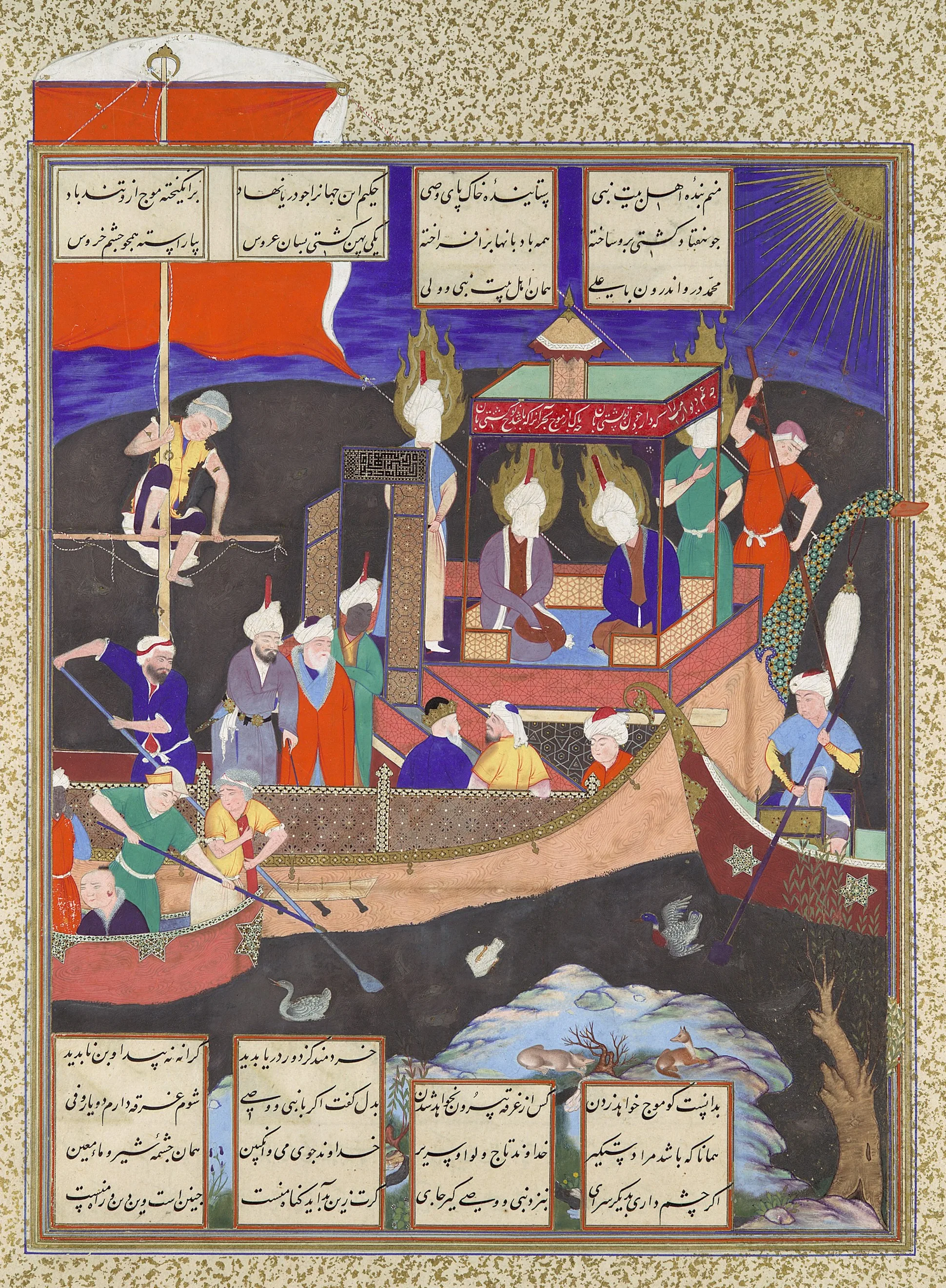
- The parable of the ship, from the opening of the Shahnameh. Shahnameh of Shah Tahmasp, folio 18v, Tabriz, about 1530 to 1535, painting attributed to Mirza Ali. The Metropolitan Museum of Art, 1970.301.1, CC0., The Metropolitan Museum of Art collection, license CC0 1.0
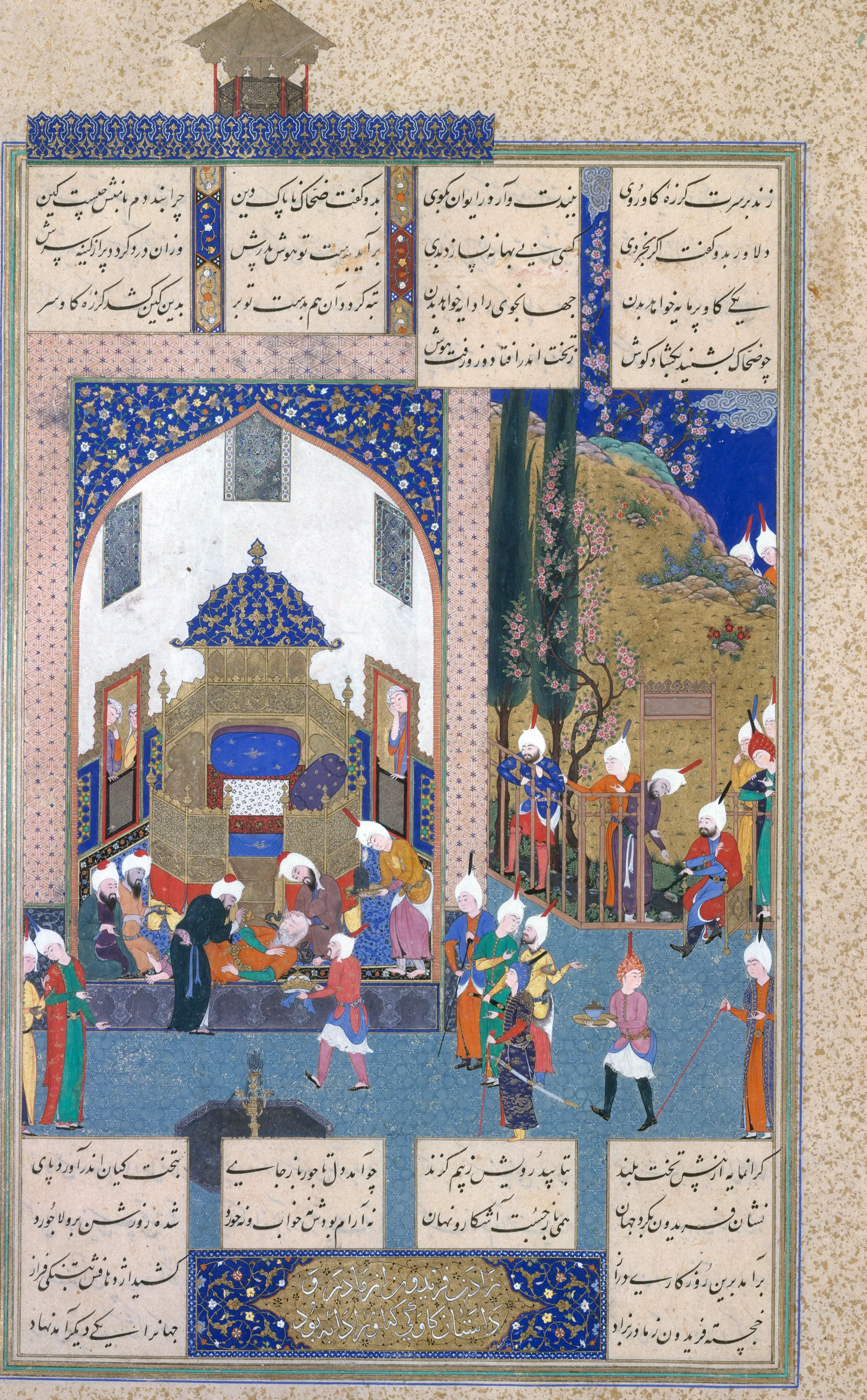
- Zahhak, who took the throne of Jamshid, hears his fate in a dream. Shahnameh of Shah Tahmasp, folio 29v, Tabriz, about 1524, painting attributed to Sultan Muhammad. The Metropolitan Museum of Art, 1970.301.4, CC0., The Metropolitan Museum of Art collection, license CC0 1.0
The facts
- Encyclopaedia Iranica: Ferdowsi, Jamšid, Šāh-nāma, Persepolis, Dārā(b), Kayāniān, Dj. Khaleghi-Motlagh, M. Omidsalar, P. O. Skjærvø, A. Sh. Shahbazi and others, Facts only, no text copied