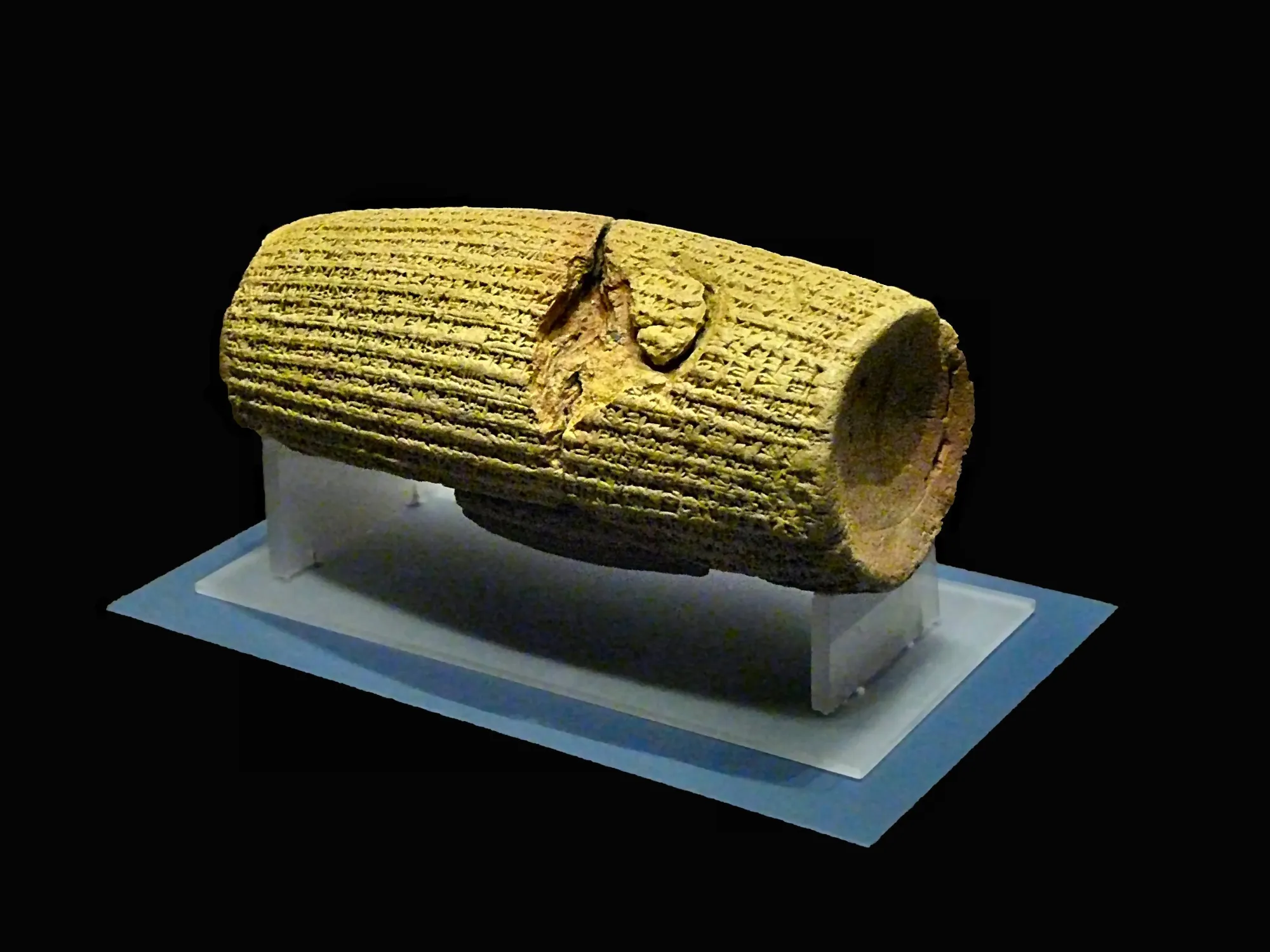
Babylon, after 539 BC
The Cyrus Cylinder
استوانهٔ کوروش
Turn the clay barrel in 3D, and read its 45 lines word by word, with the gaps that time made.
The Cyrus Cylinder
A clay cylinder from Babylon
After Cyrus took Babylon in 539 BC, scribes wrote a building inscription in his name on a barrel of clay. It went into the foundations of Imgur-Enlil, the great wall of Babylon.
The cylinder is not in Old Persian. Its language is Babylonian Akkadian, in the Babylonian cuneiform script of the scribes of Babylon. The 36 signs of Old Persian do not read it.
It is a Babylonian royal building inscription. It is not an "edict" or a "decree". Its model is an older cylinder of Ashurbanipal, whose inscription Cyrus says he saw (line 43).
The text says that Nabonidus, the last king of Babylon, did not respect the gods. Marduk, the god of the city, then chose Cyrus, and Cyrus entered Babylon in peace.
Lines 30 to 34 send gods and people back to named cities east of the Tigris and in Sumer and Akkad. The text names no Jews, no Judah and no Jerusalem. The return of the Jews is a separate account, in the Bible (Ezra 1).
The label "the first charter of human rights" is modern. It comes from the Iranian commemoration of 1971. The British Museum and the scholars reject it, because the text says nothing of human rights.
A "translation" that speaks of freedom of religion, an end to slavery and Ahuramazda goes around online. It is a modern fake. The text below is the scholarly translation.
- Found
- Babylon, 1879, by workmen of the excavation of Hormuzd Rassam. The place is probably the Amran mound.
- Material
- Fired clay
- Size
- 21.9 to 22.8 cm long and 10 cm across at most (British Museum record)
- Language
- Babylonian Akkadian, in Babylonian cuneiform
- Lines
- 45. Parts of lines 36 to 45 are on a fragment from Yale, NBC 2504, now joined to the back.
- Now
- The British Museum, London (BM 90920)
The text, line by line
Square brackets mark a restoration of broken text. Round brackets mark words that the translator added. The line numbers are the lines of the cylinder.
Cyrus II 01, the Cyrus Cylinder (Q006653), Royal Inscriptions of Babylonia online (RIBo), Oracc, Translated by Jamie Novotny, adapted from I. Finkel 2013. Lemmatized by Alexa Bartelmus and Bastian Still, license CC BY-SA 3.0
The restored signs of lines 1-45
- Restored from an ancient copy48 of 223 restored signsSource: the tablet copies BM 47134 and BM 47176.
- Restored by editors175 of 223 restored signsSource: the editors of the text, from a fixed formula, a parallel text or the sense.
Lines 1-5
[When the god Mard]uk, the king of all of heaven and earth, [... who] lays to waste his [...] ... [through] his ..., [... bro]ad in intelligence, ... [..., the one who inspects the (four) qu]arters (of the world), [...], his eldest [off]spring (Belshazzar), a lowly person, was installed as the ruler of his land, [...] he caused [..., a re]plica, to be set up over them. He bu[ilt] a replica of Esagil [and ...] for (the city) Ur and the rest of the cult-center(s).
- Lines 1 and 2 are also on a tablet copy, BM 47134.
- Belshazzar in line 3 is a name that the editors add. The clay does not name him.
The broken opening: Marduk, and the "low person" in charge
What we think those words are
Line 1
(Restored by editors:) i-nu {d}AMAR.(Restored from an ancient copy:) UTU LUGAL kiš-šat AN-e u KI-tim x (Lost text:) … (Restored by editors:) ša₂ ina (Restored from an ancient copy:) x-si-šu₂ u₂-nam-mu-(Restored by editors:) u₂ (Lost text:) … (Trace:) x-ni-šu₂
[When the god Mard]uk, the king of all of heaven and earth, [... who] lays to waste his [...] ... [through] his ...,
[آنگاه که مرد]وک، شاه همهٔ آسمان و زمین، […] که […] او را ویران میکند، […] به […]ِ خود،
Line 2
(Lost text:) … (Restored by editors:) ra-pa-(Restored from an ancient copy:) aš₂ uz-nam x x x (Lost text:) … (Restored by editors:) ha-a-a-iṭ ki-ib-ra-a-tim
[... bro]ad in intelligence, ... [..., the one who inspects the (four) qu]arters (of the world),
[…] با خرد گسترده، … […] آنکه چهار گوشهٔ (جهان) را میپاید، […]
Line 3
(Lost text:) … (Restored by editors:) ṣi-it lib₃-bi-šu GAL ma-ṭu-u₂ iš-šak-na a-na e-nu-tu ma-ti-šu₂
[...], his eldest [off]spring (Belshazzar), a lowly person, was installed as the ruler of his land,
[…]، نخستزادهاش (بلشزر)، مردی فرومایه، به فرمانروایی سرزمینش گمارده شد.
What this section is about
The opening praised Marduk as the king of heaven and earth. We know this from a later clay tablet copy, not from the cylinder. The "low person" put in charge of the land in line 3 is most likely Belshazzar, son of Nabonidus, but his name is not on the clay and the word "offspring" is a modern restoration.
آغاز متن مردوک را شاه آسمان و زمین میستود؛ این را از یک لوح گلی رونوشت میدانیم، نه از خود استوانه. «فرد فرومایهای» که در سطر ۳ بر سرزمین گماشته شد به احتمال زیاد بلشصر، پسر نبونید، است، اما نام او بر گل نیست و واژهٔ «فرزند» بازسازی امروزی است.
- Restored from an ancient copy
- BM 47134
- Source of the restorations
- Lines 1-2: the tablet copy BM 47134 obv. 1-4 (identified by W. G. Lambert and I. Finkel, 2009-2010; edition Finkel 2013, pp. 129-133). "Marduk" restored by Finkel from a queried UTU on the tablet. "When", "who inspects" and line 3 "[offspring]" are editorial (Finkel 2013, Novotny ARIo). The tablet holds no sign of the line 3 clause.
- Confidence: likely
- a fixed formula or a close parallel gives the words.
- "Marduk" likely (the tablet keeps part of the name); line 2 open; "his eldest son" likely; the name Belshazzar is an identification only, not on the clay.
The charges against Nabonidus
What we think those words are
Line 4
(Trace:) x (Lost text:) … tam-ši-li u₂-ša-aš₂-ki-na ṣe-ru-šu-un
[...] he caused [..., a re]plica, to be set up over them.
[…] نمونهای ساختگی [… ] را بر آنان برپا داشت.
Line 5
ta-am-ši-li e₂-sag-il₂ i-te-(Restored by editors:) pu-uš-ma x-tim a-na uri₂{KI} u₃ si-it-ta-ti₃ ma-ha-za
He bu[ilt] a replica of Esagil [and ...] for (the city) Ur and the rest of the cult-center(s).
نمونهای ساختگی از اِسَگیل ساخت [و …] برای (شهر) اور و دیگر شهرهای آیینی.
Line 6
pa-ra-aṣ la si-ma-ti-šu-nu ta-(Restored by editors:) ak-li-im la me-si (Lost text:) … (Restored by editors:) la pa-lih u₂-mi-ša-am-ma id-de-ne₂-eb-bu-ub u₃ a-na ma-ag-ri-tim
Daily, he devised cultic rites that were not befitting them, [impure] food of[ferings, ..., dis]respectful [...] and, as a spiteful act,
هر روز آیینهایی ناشایستِ آنان میساخت، پیشکشهای خوراکیِ [ناپاک …]، [بی]حرمتی […]، و از سرِ کینه
Line 7
sat-tuk-ku u₂-šab-ṭi-li u₂-la-(Restored by editors:) ap-pi-it pel₂-lu-de-e (Lost text:) … (Restored by editors:) iš-tak-ka-an qe₂-reb ma-ha-zi pa-la-ha {d}AMAR.UTU LUGAL DINGIR.MEŠ ig-mur kar-šu-uš-šu
he brought sattukku-offering to a halt, int[erfered with pelludû-rites (and) est]ablished [...] inside cult-centers. Reverence for the god Marduk, the king of the gods, c[ame to an en]d in his mind.
پیشکشهای روزانه را بازداشت، [در آیینها دست برد و …] را در درون شهرهای آیینی برقرار کرد. پروای مردوک، شاه خدایان، در دلش [به پایان رسید].
Line 8
le-mu-ut-ti URU-šu (Restored by editors:) i-te-ne₂-ep-pu-uš u₄-mi-ša-am-ma (Trace:) x x (Lost text:) … UN.MEŠ-šu₂ i-na ab-ša-a-ni la ta-ap-šu-uh₂-tim u₂-hal-li-iq kul-lat-si-in
Daily, [he was pe]rforming evil deeds against his city (Babylon); ... [...] his [pe]ople, he brought ruin on all of them with an unrelenting yoke.
هر روز به شهرِ او (بابل) بدی میکرد؛ … […] مردمانش را با یوغی بیامان، همه را، به نابودی کشاند.
What this section is about
This is the charge sheet against Nabonidus: a "replica" of Esagil for Ur, improper rites and halted offerings. The charges are on the clay, but the Babylonian Chronicle says the offerings went on "as in normal times", and the missing words are proposals of the editors.
این بخش کیفرخواست نبونید است: «بدلی» از اِسَگیل برای شهر اور، آیینهای نابجا و بازداشتن قربانیها. اتهامها بر گل هستند، اما گاهنامهٔ بابلی میگوید قربانیها «مانند روزهای عادی» ادامه داشت، و واژههای افتاده پیشنهاد ویراستاران است.
- Source of the restorations
- Editorial only, no duplicate. Weissbach 1911, Schaudig 2001 (via Cogan 2003), Finkel 2013, Novotny ARIo. "pelludû" (line 7) is probably Finkel's restoration, after the Babylon Stele of Nabonidus.
- Confidence: likely
- a fixed formula or a close parallel gives the words.
- The charges are on the clay (certain). The restored words are likely to open.
Lines 6-8
Daily, he devised cultic rites that were not befitting them, [impure] food of[ferings, ..., dis]respectful [...] and, as a spiteful act, he brought sattukku-offering to a halt, int[erfered with pelludû-rites (and) est]ablished [...] inside cult-centers. Reverence for the god Marduk, the king of the gods, c[ame to an en]d in his mind. Daily, [he was pe]rforming evil deeds against his city (Babylon); ... [...] his [pe]ople, he brought ruin on all of them with an unrelenting yoke.
Lines 9-10
The Enlil of the gods became furiously angry at their complaints an[d ...] their territory. The gods living inside them abandoned their shrines, angry that he had made (them) enter Šuanna (Babylon). The god Marduk, the ex[alted one, the Enlil of the god]s, relented; [his] (hostile) attit[ude] changed towards all of the inhabited settlements whose dwellings were in ruins and the people of the land of Sumer and Akkad who had become like corpses; he became forgiving.
The gods leave, Marduk relents
What we think those words are
Line 9
a-na ta-zi-im-ti-ši-na {d}EN.LIL₂ DINGIR.MEŠ ez-zi-iš i-gu-ug-ma (Lost text:) … ki-su-ur₂-šu-un DINGIR.MEŠ a-ši-ib lib₃-bi-šu-nu i-zi-bu at-ma-an-šu-un
The Enlil of the gods became furiously angry at their complaints an[d ...] their territory. The gods living inside them abandoned their shrines,
انلیلِ خدایان (مردوک) از نالههای آنان سخت خشمگین شد [و …] قلمرو آنان. خدایانی که در آنها میزیستند، پرستشگاههایشان را رها کردند،
Line 10
i-na ug-ga-ti-ša u₂-še-ri-bi a-na qe₂-reb šu-an-na{KI} {d}AMAR.UTU ti-(Restored by editors:) iz-qa-ru {d}EN.LIL₂ DINGIR.MEŠ us-sa-ah-ra a-na nap-har da-ad₂-mi ša in-na-du-u₂ šu-bat-su-un
angry that he had made (them) enter Šuanna (Babylon). The god Marduk, the ex[alted one, the Enlil of the god]s, relented; [his] (hostile) attit[ude] changed towards all of the inhabited settlements whose dwellings were in ruins
خشمگین از اینکه او (نبونید) (آنان را) به شوانّه (بابل) آورده بود. مردوک، [آن والا، انلیلِ خدای]ان، دل نرم کرد؛ [اندیشهٔ] (خشمگینِ) [او] به سوی همهٔ آبادیهایی که خانههایشان ویران بود، بازگشت
Line 11
u₃ UN.MEŠ KUR-šu-me-ri u₃ URI{KI} ša i-mu-u₂ ša-lam-ta-aš₂ u₂-sa-ah-hi-ir ka-bat-(Restored by editors:) ta-aš₂ ir-ta-ši ta-a-a-ra kul-lat ma-ta-a-ta ka-li-ši-na i-hi-iṭ ib-re-e-ma
and the people of the land of Sumer and Akkad who had become like corpses; he became forgiving. He (Marduk) inspected (and) examined all of the lands, everyone of them,
و به سوی مردم سرزمین سومر و اکد که همچون مردگان شده بودند؛ و بر آنان بخشایش آورد. او (مردوک) همهٔ سرزمینها را، یکایک، کاوید و نگریست
What this section is about
In 539 Nabonidus brought the statues of many gods into Babylon for safety, and the Chronicle records it. The cylinder turns this into an outrage that made Marduk take pity on the people. Almost all of this part is on the clay. Only Marduk's epithet in line 10 is restored, from line 9.
در سال ۵۳۹ پ.م. نبونید پیکرهٔ بسیاری از خدایان را برای ایمنی به بابل آورد و گاهنامه این را ثبت کرده است؛ استوانه همین کار را گناهی مینماید که مردوک را به بخشایش مردم واداشت. تقریباً همهٔ این بخش بر گل مانده است و تنها لقب مردوک در سطر ۱۰ از روی سطر ۹ بازسازی شده است.
- Source of the restorations
- Editorial, from line 9 ("Enlil of the gods"). The restoration predates Finkel (in Cogan 2003 after Schaudig 2001; probably Berger 1975 or Schaudig 2001).
- Confidence: certain
- a duplicate copy holds the words, or the words are on the stone.
- Certain for the sense (almost all on the clay). Marduk's epithet in line 10 is likely.
Lines 11-14
He (Marduk) inspected (and) examined all of the lands, everyone of them, and constantly sought out a righteous king, the desire of his heart. He took Cyrus (II), the king of Anšan, into his hand, called (him) by his name, (and) proclaimed him (lit. “his name”) to be the ruler of the entirety of everything. He made the land of the Gutians (and) all of the Umman-manda (Medes) bow down at his feet. (As for) the black-headed people whom he allowed his hand to conquer, he was assiduous towards their welfare in truth and justice. The god Marduk, the great lord, the one who nurtures his people, look[ed] with pleasure upon his good deeds and righteous heart.
Lines 15-17
He (Marduk) commanded that he (Cyrus) should march against his city, Babylon. He made him take the road to Babylon and, like a friend and companion, he marched at his side. His widespread troops, whose number, like the water of a river, cannot be ascertained, marched fully armed at his side. Without a fight or battle, he allowed him to enter Šuanna (Babylon). He saved his city, Babylon, from hardship. He delivered Nabonidus, the king who did not revere him, into his hands.
Lines 18-19
The people of Babylon, all of them, the entirety of the land of Sumer and Akkad, (as well as) the nobles and governor(s), bowed down before him (and) kissed his feet. They were happy at him being king (and) their faces shone. (As for) the lord, who through his (Marduk’s) support revived the dying (and) universally spared (them) from trouble and hardship, they graciously blessed him (and) praised his name.
Lines 20-22
I, Cyrus (II), king of the world, great king, strong king, king of Babylon, king of the land of Sumer and Akkad, king of the four quarters (of the world), son of Cambyses (I) — great king, king of Anšan — grandson of Cyrus (I) — great king, kin[g of] Anšan — descendant of Teispes — great king, king of Anšan — the eternal seed of kingship, whose reign the gods Bēl (Marduk) and Nabû love and whose k[ingshi]p they desired to their heart’s content. When I peacefully entered i[n]to Babylon, amidst joy and happiness, I took up (my) lordly residence in the palace of the ruler.
Lines 23-25
The god Marduk, the great lord, established for me as (my) des[ti]ny the great magnanimity of one who loves Babylon and daily I strive to revere him. My widespread troops marched peacefully inside Babylon. I did not allow the whole of the lan[d of Sumer] and Akkad to have troublemakers. I sought out the welfare of the city of Babylon and all of its shrines. (As for) the citizens of Babylon, [..., wh]o would have endured a yoke not befitting them if not for the wi[ll of go]d, I allowed (them) to find rest for their exhaustion (and) I relieved (them) off their ...
- Lines 25 and 26 are uncertain. The last word of line 25 is broken, and other editions read it in other ways. The text makes no sure statement of freedom here.
The peaceful entry and the "yoke"
What we think those words are
Line 24
um-ma-ni-ia rap-ša-tim i-na qe₂-reb TIN.TIR{KI} i-ša-ad-di-ha šu-ul-ma-niš nap-har KUR-(Restored by editors:) šu-me-ri u₃ URI{KI} mu-gal-li-tim ul u₂-šar-ši
My widespread troops marched peacefully inside Babylon. I did not allow the whole of the lan[d of Sumer] and Akkad to have troublemakers.
سپاهیان گستردهام با آرامش در درون بابل گام برمیداشتند. نگذاشتم در همهٔ سرزمین [سومر] و اکد کسی آشوب کند.
Line 25
URU{KI} KA₂.DINGIR.RA{KI} u₃ kul-lat ma-ha-zi-šu i-na ša-li-im-tim aš₂-te-eʾ-e DUMU.MEŠ TIN.TIR(Restored by editors:) {KI} (Lost text:) … ša ki-ma la lib₃-(Restored by editors:) bi DINGIR-ma ab-ša₂-a-ni la si-ma-ti-šu₂-nu šu-ziz-zu
I sought out the welfare of the city of Babylon and all of its shrines. (As for) the citizens of Babylon, [..., wh]o would have endured a yoke not befitting them if not for the wi[ll of go]d,
آسایش شهر بابل و همهٔ پرستشگاههایش را جستم. و اما شهروندان بابل، […] که برخلافِ خواستِ [خدا] یوغی ناشایست بر آنان نهاده بودند،
Line 26
an-hu-ut-su-un u₂-pa-aš₂-ši-ha u₂-ša-ap-ṭi-ir sa-ar-ma-šu-nu a-na ep-še-e-ti-(Restored by editors:) ia dam-qa-a-ti {d}AMAR.UTU EN GAL-u₂ ih-de-e-ma
I allowed (them) to find rest for their exhaustion (and) I relieved (them) off their ... The god Marduk, the gre[a]t lord, was pleased with [my good] deeds and
خستگیشان را آرامش دادم و از …شان رهایشان کردم. مردوک، سرور بزرگ، از کارهای [نیک من] شاد شد و
What this section is about
Cyrus says his army entered Babylon in peace and that he lifted a "yoke", most likely forced building labour, from the citizens. No word on the clay says "I abolished": that verb is a restoration of 1950, and the key word of line 26 is still read as "corvée", "burden" or "bonds".
کوروش میگوید سپاهش با آرامش به بابل درآمد و «یوغی»، به احتمال زیاد بیگاری ساختمانی، را از دوش شهروندان برداشت. هیچ واژهای بر گل نمیگوید «برانداختم»؛ این فعل بازسازی سال ۱۹۵۰ است، و واژهٔ کلیدی سطر ۲۶ هنوز «بیگاری»، «بار» یا «بند» خوانده میشود.
- Source of the restorations
- Editorial only (fixed formulas: "Sumer and Akkad", "my good deeds"). "[I abolished]" exists only in Oppenheim 1950 (ANET); no later editor restores it. The word sarmašunu (line 26) is on the clay but its sense is open: corvée (Schaudig 1995), service (Cogan 2003), bonds(?) (Finkel), burden(?) (van der Spek 2014), untranslated (Novotny).
- Confidence: likely
- a fixed formula or a close parallel gives the words.
- The restored signs are likely. The gap in line 25 and the sense of sarmašunu are open.
Lines 26-29
The god Marduk, the gre[a]t lord, was pleased with [my good] deeds and he kindly pronounced a blessing over me – Cyrus (II), the king who reveres him — and Cambyses (II) — the son, [my] offspring — [and] the entir[ety of] my army so that we, [at his] exalted [command], could constantly walk about happily before him in good health. All of the kings who sit on (royal) daises, from every quarter (of the world), from the Upper Sea to the Lower Sea, those who live in [remote] re[gions], (and) the kings of the land of Amurru who live in tents, everyone of them, brought their substantial tribute inside Šuanna (Babylon) (and) kissed my feet.
The blessing, and the tribute of the kings
What we think those words are
Line 27
a-na ia-a-ti {m}ku-ra-aš₂ LUGAL pa-li-ih-šu u₃ {m}ka-am-bu-zi-ia DUMU ṣi-it lib₃-bi-(Restored by editors:) ia u₃ a-na nap-har um-ma-ni-ia
he kindly pronounced a blessing over me – Cyrus (II), the king who reveres him — and Cambyses (II) — the son, [my] offspring — [and] the entir[ety of] my army
بر من، کوروش، شاهی که او را میپرستد، و بر کمبوجیه، پسرم، پارهٔ تنم، [و بر] همهٔ سپاهم
Line 28
da-am-qi₂-iš ik-ru-ub-ma i-na ša₂-lim-tim ma-har-ša ṭa-bi-iš ni-it-ta-(Restored by editors:) al-la-ak i-na qi₂-bi-ti-šu₂ ṣir-ti nap-har LUGAL a-ši-ib BARA₂.MEŠ
so that we, [at his] exalted [command], could constantly walk about happily before him in good health. All of the kings who sit on (royal) daises,
به نیکی برکت فرستاد، تا ما [به فرمانِ] والای او، با تندرستی و شادی در برابرش گام برداریم. همهٔ شاهانی که بر تخت نشستهاند،
Line 29
ša ka-li-iš kib-ra-a-ta iš-tu tam-tim e-li-tim a-di tam-tim šap-li-tim a-ši-ib na-(Restored by editors:) gi-i ne₂-su-tim LUGAL.MEŠ KUR a-mur-ri-i a-ši-ib kuš-ta-ri ka-li-šu₂-un
from every quarter (of the world), from the Upper Sea to the Lower Sea, those who live in [remote] re[gions], (and) the kings of the land of Amurru who live in tents, everyone of them,
از همهٔ گوشههای (جهان)، از دریای بالا تا دریای پایین، آنان که در [سرزمینهای دوردست] میزیند، و همهٔ شاهان سرزمین اَمورو که در چادر میزیند،
What this section is about
Marduk blesses Cyrus, his son Cambyses and the army, and the kings "from the Upper Sea to the Lower Sea" bring tribute. The broken words are standard phrases of earlier Assyrian royal texts, and the Chronicle confirms that Cambyses stood beside his father at the New Year rite of 538.
مردوک کوروش، پسرش کمبوجیه و سپاه را برکت میدهد و شاهان «از دریای بالا تا دریای پایین» باج میآورند. واژههای شکسته عبارتهای جاافتادهٔ کتیبههای شاهان آشوری پیشیناند، و گاهنامه تأیید میکند که کمبوجیه در آیین سال نو ۵۳۸ پ.م. در کنار پدرش بود.
- Source of the restorations
- Editorial only, from fixed formulas: ṣīt libbiya, ina qibītišu ṣirti, āšib nagî nesûti. The syntax of line 28 is open (Finkel older text and Novotny against Finkel later text, eBL and van der Spek 2014).
- Confidence: likely
- a fixed formula or a close parallel gives the words.
- Likely (fixed formulas). Whether "at his exalted command" goes with Cyrus or with the kings is open.
Lines 30-32
From [Šuanna (Babylon)] to Aššur and Susa, Agade, Ešnunna, Zabbān, Mê-Turān, Dēr, as far as the border of the land of the Gutians, (and) cult-centers on the opposite side of the Tigris River whose dwellings had previous been in ruins — I returned the deities who live inside them to their (proper) places and I made (them) reside in (their) eternal dwelling(s). I gathered (together) all of their people and returned (them to) their settlements.
The return of the gods and of the peoples
What we think those words are
Line 30
bi-lat-su-nu ka-bi-it-tim u₂-bi-lu-nim-ma qe₂-er-ba šu-an-na{KI} u₂-na-aš₂-ši-qu še-pu-u₂-a iš-tu (Restored by editors:) šu-an-na{KI} a-di {URU}aš-šur{KI} u₃ MUŠ₃.EREN{KI}
brought their substantial tribute inside Šuanna (Babylon) (and) kissed my feet. From [Šuanna (Babylon)] to Aššur and Susa,
باجِ سنگینِ خود را به شوانّه (بابل) آوردند و پاهایم را بوسیدند. از [شوانّه (بابل)] تا آشور و شوش،
Line 31
a-ka₃-de₃{KI} {KUR}eš₃-nu-nak {URU}za-am-ba-an {URU}me-tur₂-nu BAD₃.DINGIR{KI} a-di pa-aṭ {KUR}qu-ti-i ma-ha-za (Restored by editors:) e-ber-ti {ID₂}IDIGNA ša iš-tu pa-na-ma na-du-u₂ šu-bat-su-un
Agade, Ešnunna, Zabbān, Mê-Turān, Dēr, as far as the border of the land of the Gutians, (and) cult-centers on the opposite side of the Tigris River whose dwellings had previous been in ruins —
اکد، اِشنونا، زَمبان، مهتورنو، دِر، تا مرز سرزمین گوتی، و شهرهای آیینیِ آن سوی دجله که خانههایشان از دیرباز ویران بود،
What this section is about
Cyrus sent home the gods of cities east of the Tigris and the gods of Babylonian towns that Nabonidus had gathered in Babylon. The Chronicle dates the second return to December 539 to March 538. The text names no Jews and no Jerusalem, and its first word, "[from Babylon]", is a restoration that one editor reads "[from Nineveh?]".
کوروش خدایان شهرهای آن سوی دجله و خدایان شهرهای بابلی را که نبونید در بابل گرد آورده بود به جای خود بازگرداند؛ گاهنامه بازگشت گروه دوم را میان دسامبر ۵۳۹ و مارس ۵۳۸ پ.م. میگذارد. متن نامی از یهودیان و اورشلیم نمیبرد، و نخستین واژهٔ فهرست، «[از بابل]»، بازسازی است که یک ویراستار آن را «[از نینوا؟]» میخواند.
- Source of the restorations
- Editorial. "[Šuanna]" (Finkel, Novotny; "[Babylon]" van der Spek 2014) against "[Nineveh?]" (Schaudig 2019, via Tiemeyer 2024). "[e]" of ebertu is near certain.
- Confidence: open
- the words are lost, or the editors read them differently.
- The place names are on the clay (certain). The first word of the list is open.
Lines 33-36
Moreover, (as for) the deities of the land of Sumer and Akkad who Nabonidus, incurring the wrath of the lord of the gods (Marduk), had brought into Šuanna (Babylon), at the command of the god Marduk, the great lord, I allowed (them) to live in peace in their abodes, (in) the dwelling(s) of (their) heart’s content. May all of the deities whom I made enter into their cult-centers speak daily about my life being long (and) may they mention favorable words about me in the presence of the gods Bēl (Marduk) and Nabû. Furthermore, may they say this to the god Marduk, my lord: “[(As for) the ...] of Cyrus (II), the king who reveres you, and Cambyses (II), his son, [...] may they be the ones who provision our shrines until distant days.” Also, the people of Babylon blessed (my) kingship. I allowed the lands, all of them, to live undisturbed.
- Lines 34 to 37 are also on a tablet copy, BM 47176, by the museum record. eBL and van der Spek 2014 give lines 33 to 37.
- The end of the quoted prayer in line 35 is a restoration.
The end of the gods' prayer, and the bird offerings
What we think those words are
Line 36
ku (Trace:) x (Restored by editors:) x x x ib šu-nu lu-u₂ za-ni-ni (Trace:) x-x-x (Restored from an ancient copy:) BARA₂-i-ni a-na UD.MEŠ SU₃.(Restored by editors:) MEŠ (Lost text:) … u₃ UN.MEŠ TIN.TIR{KI} ik-tar-ra-bu LUGAL-u₂-tu KUR.KUR ka-li-ši-na šu-ub-ti ne₂-eh-tim u₂-še-ši-ib
[...] may they be the ones who provision our shrines until distant days.” Also, the people of Babylon blessed (my) kingship. I allowed the lands, all of them, to live undisturbed.
[…] باشد که آنان تا روزگاران دور روزیرسانِ پرستشگاههای ما باشند.» و مردم بابل پادشاهی (مرا) ستودند. همهٔ سرزمینها را در آرامش نشاندم.
Line 37
(Lost text:) … (Restored by editors:) KUR.GI{MUŠEN} 2 UZ.TUR{MUŠEN} u₃ 10 TU.GUR₄{MUŠEN}.MEŠ e-li KUR.GI{MUŠEN} UZ.TUR{MUŠEN}.MEŠ u₃ TU.GUR₄{MUŠEN}.MEŠ
Daily, I lavishly provided [... ge]ese, two ducks, and ten pigeons, more than the geese, ducks, and pigeons [...].
[… غا]ز، دو اردک و ده کبوتر، بیش از غازها، اردکها و کبوترهای [پیشین …] هر روز به فراوانی پیشکش کردم.
What this section is about
The returned gods pray that Cyrus and Cambyses "be the provisioners of our shrines until distant days". A clay tablet copy identified in 2009-2010 holds these words. Then Cyrus boasts that he added geese, ducks and doves to the daily offerings, an answer to the charge that Nabonidus had stopped them.
خدایان بازگشته دعا میکنند که کوروش و کمبوجیه «تا روزهای دور روزیرسان پرستشگاههای ما باشند»؛ لوحی گلی که در ۲۰۰۹ تا ۲۰۱۰ شناسایی شد این واژهها را نگه داشته است. سپس کوروش میبالد که غاز، اردک و کبوتر بر قربانیهای روزانه افزود، پاسخی به این اتهام که نبونید قربانیها را بازداشته بود.
- Restored from an ancient copy
- BM 47176
- Source of the restorations
- Line 36: the tablet copy BM 47176 line 5' (identified by W. G. Lambert, 2009-2010; Finkel 2013). SUD only half on the tablet, the last MEŠ editorial. Line 37: the tablet holds only traces; [KUR] from the same word later in the line; the gap at the start is editorial (the number of geese).
- Confidence: certain
- a duplicate copy holds the words, or the words are on the stone.
- Line 36 certain (a duplicate copy holds it), except its first words (open). The start of line 37 is likely in sense, open in its words.
Line 37
Daily, I lavishly provided [... ge]ese, two ducks, and ten pigeons, more than the geese, ducks, and pigeons [...].
Lines 38-41
(As for) the wall Imgur-Enlil, the great wall of Babylon, I sought to strengthen its [defen]ses and [...] the quay (made) of baked brick on the bank of the moat that a previous king had bu[ilt, but not com]pleted, [I ...] its construction. [(As for) ..., which did not surround the city] on the outside, which no previous king had built, his troops, the lev[y of his land, in]to Šuanna (Babylon) [...] I built anew with bitumen and baked brick and [completed the]ir [construction].
The building work on the walls of Babylon
What we think those words are
Line 38
(Lost text:) … (Restored by editors:) u₄-mi-šam u₂-ṭa-ah-hi-id {BAD₃}im-gur-{d}EN.LIL₂ BAD₃ GAL-a ša TIN.TIR{KI} (Restored by editors:) ma-aṣ-ṣar-ta-šu₂ du-un-nu-num aš₂-te-eʾ-e-ma
(As for) the wall Imgur-Enlil, the great wall of Babylon, I sought to strengthen its [defen]ses and
و اما دیوار ایمگورانلیل، دیوار بزرگ بابل: در پیِ استوار کردنِ [باروها]یش برآمدم و
Line 39
(Lost text:) … ka-a-ri a-gur-ru ša₂ GU₂ ha-ri-ṣi ša LUGAL mah-ri i-pu-(Restored by editors:) šu-ma la u₂-šak-li-lu ši-pi-ir-šu
[...] the quay (made) of baked brick on the bank of the moat that a previous king had bu[ilt, but not com]pleted, [I ...] its construction.
[…] اسکلهای از آجر پخته بر کنارهٔ خندق، که شاهی پیشین ساخته [ولی به پایان نر]سانده بود، [من …] کارش را.
Line 40
(Lost text:) … (Restored by editors:) la u₂-ša-as-hi-ru URU a-na ki-da-a-ni ša LUGAL ma-ah-ra la i-pu-šu um-man-ni-šu di-ku-ut (Restored by editors:) ma-ti-šu i-na qe₂-reb šu-an-na{KI}
[(As for) ..., which did not surround the city] on the outside, which no previous king had built, his troops, the lev[y of his land, in]to Šuanna (Babylon) [...]
[و اما …، که شهر را] از بیرون [در بر نمیگرفت]، که هیچ شاه پیشینی نساخته بود، با سپاهیانش، بیگاریانِ [سرزمینش، در] شوانّه (بابل) […]
Line 41
(Lost text:) … (Restored by editors:) i-na ESIR.UD.DU.A u₃ SIG₄.AL.UR₃.RA eš-ši-iš e-pu-uš-ma (Restored by editors:) u₂-šak-lil ši-pir-ši-in
I built anew with bitumen and baked brick and [completed the]ir [construction].
[…] با قیر و آجر پخته از نو ساختم و [ساختِ آنها را به پایان رساندم].
Line 42
(Lost text:) … (Restored by editors:) {GIŠ}IG.MEŠ {GIŠ}EREN MAH.MEŠ ta-ah-lu-up-ti₃ ZABAR as-ku-up-pu u₃ nu-ku-še-(Restored by editors:) e pi-ti-iq e-ri-i e-ma KA₂.MEŠ-ši-na
[... tall doors of cedar] covered with bronze. [Wherever th]eir [gates were, I installed] thresholds and fittin[gs of cast copper].
[… درهای بلند از چوب سدر] با روکش مفرغ. [هر جا که دروازههای]شان [بود، آستانهها و چفتوبستهایی از مسِ ریختهگریشده نهادم].
What this section is about
Like every king of Babylon before him, Cyrus reports work on Imgur-Enlil, the great city wall, the brick quay of the moat and cedar doors clad in bronze. No ancient copy holds the gaps, but the editors filled them from almost identical sentences of Nabopolassar, Nebuchadnezzar and Ashurbanipal.
کوروش، مانند همهٔ شاهان پیشین بابل، از کار بر ایمگور-اِنلیل، بارهٔ بزرگ شهر، اسکلهٔ آجری خندق و درهای سدر با روکش مفرغ گزارش میدهد. هیچ رونوشت کهنی این افتادگیها را ندارد، اما ویراستاران آنها را از جملههای تقریباً یکسانِ نبوپولسر، نبوکدنصر و آشوربانیپال پر کردهاند.
- Source of the restorations
- Editorial only (the tablet BM 47134 holds two traces of line 42). Near word-for-word models on Oracc: Ashurbanipal 241 (L6) lines 19-20 (line 38), Nabopolassar 1 lines 12-15 (line 40), Nabonidus 28 iii 5 (line 41), Nebuchadnezzar II 2 ix 9-16 (line 42). Most signs on the stone are on the Yale fragment NBC 2504 (Walker 1972, Berger 1975).
- Confidence: likely
- a fixed formula or a close parallel gives the words.
- Likely (fixed formulas and close parallels). Whose troops in line 40, which outer work, and which previous king are open.
Line 42
[... tall doors of cedar] covered with bronze. [Wherever th]eir [gates were, I installed] thresholds and fittin[gs of cast copper].
- Lines 42 to 45 are also on the tablet copy BM 47134.
Line 43
[... I saw a ... wr]itten in the name of Ashurbanipal, a king who came before [me, that (had been deposited) inside it. ... to] its [plac]e.
The inscription of Ashurbanipal
What we think those words are
Line 43
(Restored by editors:) u₂-rat-ta-a (Lost text:) … ši-ṭi-ir šu-mu ša₂ {m}AN.ŠAR₂-DU₃-IBILA LUGAL a-lik mah-ri-(Restored by editors:) ia ša₂ qer-ba-šu ap-pa-al-sa
[... I saw a ... wr]itten in the name of Ashurbanipal, a king who came before [me, that (had been deposited) inside it. ...]
[… دیدم نوشتهای … ] به نام آشوربانیپال، شاهی که پیش از [من بود، که در درون آن نهاده بودند …]
Line 44
(Lost text:) … (Restored by editors:) a-na aš₂-(Restored from an ancient copy:) ri-šu₂ {d}AMAR.UTU EN GAL ba-(Restored from an ancient copy:) laṭ (Restored by editors:) UD.MEŠ u₃-ti₃ (Restored by editors:) SU₃.MEŠ
[... to] its [plac]e. O Marduk, the great lord, [grant me] a lif[e (lasting until) distant days,
[… به جای]ش [بازگرداندم]. ای مردوک، سرور بزرگ، [به من ببخش] زندگی[ای تا روزگاران دور،
What this section is about
In the wall the workmen found an inscription of the Assyrian king Ashurbanipal, and Cyrus says that he put it back in its place, as Ashurbanipal's own text asked a later king to do. The name is on the clay; "I saw it inside" and "to its place" follow exact formulas of Nabonidus.
کارگران در دیوار کتیبهای از آشوربانیپال، شاه آشور، یافتند و کوروش میگوید آن را به جای خود بازگرداند، همانگونه که متن خود آشوربانیپال از شاهان آینده خواسته بود. نام بر گل است؛ «آن را درون آن دیدم» و «به جایش» از عبارتهای دقیق نبونید پیروی میکنند.
- Restored from an ancient copy
- BM 47134
- Source of the restorations
- Editorial, from Nabonidus 1 ii 5-6 and Nabonidus 28 ii 46 (Schaudig 2001, p. 554, "based on collation", via Michalowski 2014). The tablet BM 47134 rev. 2'-3' confirms the name and "[... its pla]ce".
- Confidence: likely
- a fixed formula or a close parallel gives the words.
- The name is certain (on the stone and on the tablet). "I saw it inside" and "to its place" are likely.
Lines 44-45
O Marduk, the great lord, [grant me] a lif[e (lasting until) distant days, the attainment of very old age, the securing of (my) throne, and the prolongation of (my) reig]n as a gif[t. Furthermore, may I ... in] your heart for ever.
- Most of this closing prayer is a restoration, from the usual formula of such texts and from the tablet copy.
The closing prayer to Marduk
What we think those words are
Line 44
(Lost text:) … (Restored by editors:) a-na aš₂-(Restored from an ancient copy:) ri-šu₂ {d}AMAR.UTU EN GAL ba-(Restored from an ancient copy:) laṭ (Restored by editors:) UD.MEŠ u₃-ti₃ (Restored by editors:) SU₃.MEŠ
[... to] its [plac]e. O Marduk, the great lord, [grant me] a lif[e (lasting until) distant days,
[… به جای]ش [بازگرداندم]. ای مردوک، سرور بزرگ، [به من ببخش] زندگی[ای تا روزگاران دور،
Line 45
(Restored by editors:) še-be₂-e li-it-tu-u₂-ti ku-un {GIŠ}GU.ZA u₃ la-bar pa-le-(Restored from an ancient copy:) e a-na ši-ri-ik-tim (Restored by editors:) šu-ur₂-kam u₃ a-na-ku-ma (Lost text:) … (Restored from an ancient copy:) lib₃-bi-ka a-na da-ri₂-a-tim
the attainment of very old age, the securing of (my) throne, and the prolongation of (my) reig]n as a gif[t. Furthermore, may I ... in] your heart for ever.
پیری کامل، تختی استوار و فرمانروایی دیرپا] را چون هدیه[ای. و باشد که من … در] دلِ تو تا جاودان.
What this section is about
The text ends with a prayer to Marduk for a long life, old age, a firm throne and a long reign. Only "for ever" survives on the cylinder. A tablet copy and a prayer that Nebuchadnezzar used almost word for word give the rest.
متن با دعایی به مردوک برای عمر دراز، پیری، تخت استوار و فرمانروایی پایدار پایان مییابد. بر استوانه تنها «تا همیشه» مانده است؛ باقی را یک لوح رونوشت و دعایی میدهند که نبوکدنصر تقریباً واژه به واژه به کار برده بود.
- Restored from an ancient copy
- BM 47134
- Source of the restorations
- The tablet copy BM 47134 rev. 3'-5' (Marduk the great lord, "as a gift", "your heart"). The rest is editorial, from the prayer of Nebuchadnezzar II 35 ii 13-21, almost word for word. The cylinder spells "distant days" in syllables (u₄-um re-e-qu₂-u₃-ti₃, eBL).
- Confidence: likely
- a fixed formula or a close parallel gives the words.
- Likely (a fixed formula and a partial duplicate). The clause "and may I ... in your heart" is open.
Credits
Sources and licenses
Every text, image and font on this page has an open license. This list gives each source, its author and its license.
Texts
- Cyrus II 01, the Cyrus Cylinder (Q006653), Royal Inscriptions of Babylonia online (RIBo), Oracc, Translated by Jamie Novotny, adapted from I. Finkel 2013. Lemmatized by Alexa Bartelmus and Bastian Still, license CC BY-SA 3.0
- CMa, Pasargadae (Q007131), Achaemenid Royal Inscriptions online (ARIo), Oracc, Lines 1-2, after Schmitt 2009, license CC BY-SA 3.0
- The words and the phrases of the learning tools: ARIo JSON export (zip file), Oracc, After Schmitt 2009, license CC0 1.0
Fonts
- Cormorant Garamond, Google Fonts, Christian Thalmann, the Cormorant Project Authors, license SIL OFL 1.1
- Gentium Book Plus, Google Fonts, SIL International, license SIL OFL 1.1(Reserved Font Names: Gentium, SIL)
- Noto Sans Old Persian, Google Fonts, The Noto Project Authors, license SIL OFL 1.1
- Noto Sans Cuneiform, Google Fonts, The Noto Project Authors, license SIL OFL 1.1
- Noto Sans Cuneiform Landing, Google Fonts, The Noto Project Authors, license SIL OFL 1.1
- Vazirmatn, Google Fonts, Saber Rastikerdar, the Vazirmatn Project Authors, license SIL OFL 1.1
Images
- The Cyrus Cylinder, full side view of the front, British Museum: photo by Prioryman, Wikimedia Commons, license CC BY-SA 3.0
- The Cyrus Cylinder, full side view of the back, British Museum: photo by Prioryman, Wikimedia Commons, license CC BY-SA 3.0
- Close-up of the Babylonian cuneiform lines on the Cyrus Cylinder: photo by Fæ, Wikimedia Commons, license CC BY-SA 3.0
- The Cyrus Cylinder at an angle, showing one open end, on a black background: photo by dynamosquito from France, Wikimedia Commons, license CC BY-SA 2.0
- The Old Persian column of the trilingual Xerxes inscription on the rock of Van, Turkey: photo by Bjørn Christian Tørrissen, Wikimedia Commons, license CC BY-SA 3.0
- Stone foundation tablet of Xerxes I, inscription XPf, National Museum of Iran: photo by Ywpark2003 Prof. Yong Woo Park, Wikimedia Commons, license CC BY 4.0
- A panel of Old Persian cuneiform carved in stone at Persepolis, wedges clear: photo by Radosław Botev, Wikimedia Commons, license CC BY 3.0 PL
- A cuneiform inscription panel framed by two relief figures at Persepolis: photo by Ziegler175, Wikimedia Commons, license CC BY-SA 4.0
- Close-up of the cuneiform wedges of the Darius inscription at Ganjnameh, near Hamadan: photo by Adam Jones from Kelowna, BC, Canada, Wikimedia Commons, license CC BY-SA 2.0
- Foundation plate of Darius I from the Apadana at Persepolis, inscription DPh: photo by an unknown author, Wikimedia Commons, Public Domain Mark 1.0
- The ruins of Persepolis, columns and a doorway, in silhouette at sunset: photo by Bockomet, Wikimedia Commons, license CC BY-SA 4.0
- The Behistun relief: Darius the Great above the bound rebel kings, with the trilingual inscription: photo by Hamidreza Sorouri for PersianDutchNetwork, Wikimedia Commons, license CC BY-SA 4.0
- The lamassu, human-headed winged bulls, of the Gate of All Nations at Persepolis: photo by Carole Raddato, Wikimedia Commons, license CC BY-SA 2.0
- The lion attacking a bull, relief on the Apadana staircase at Persepolis: photo by ywpark2003 Prof. Yong Woo Park, Wikimedia Commons, license CC BY 4.0
- The Ionian delegation of tribute bearers on the east staircase of the Apadana, Persepolis: photo by A.Davey from Portland, Oregon, EE UU, Wikimedia Commons, license CC BY 2.0
- The tomb of Cyrus the Great at Pasargadae: photo by Diego Delso, Wikimedia Commons, license CC BY-SA 4.0
- The rock-cut royal Achaemenid tombs at Naqsh-e Rostam: photo by Alen Ištoković, Wikimedia Commons, license CC BY 3.0
- The glazed brick frieze of archers from the palace of Darius at Susa, Louvre: photo by Jastrow (2007), Wikimedia Commons, Public Domain Mark 1.0
- Map of the Achaemenid Empire at its greatest extent, about 500 BCE: map by Mossmaps (original map), corrections by पाटलिपुत्र, Wikimedia Commons, license CC BY-SA 4.0
- Ground 026, ambientCG, license CC0 1.0
- Sandstone Cracks, Poly Haven, Rob Tuytel, license CC0 1.0
- Head of a Persian guard, The Metropolitan Museum of Art collection, license CC0 1.0
- Lobed bowl with a royal inscription, The Metropolitan Museum of Art collection, license CC0 1.0
- Lobed bowl with a royal inscription, The Metropolitan Museum of Art collection, license CC0 1.0
- Cylinder seal, The Metropolitan Museum of Art collection, license CC0 1.0
- Cylinder seal, The Metropolitan Museum of Art collection, license CC0 1.0
- Cuneiform tablet impressed with seals: administrative document inscribed in Achaemenid Elamite, The Metropolitan Museum of Art collection, license CC0 1.0
- Cuneiform tablet: Gula incantation, The Metropolitan Museum of Art collection, license CC0 1.0
- Cuneiform cylinder: inscription of Nebuchadnezzar II describing the construction of the outer city wall of Babylon, The Metropolitan Museum of Art collection, license CC0 1.0
- Cuneiform cylinder: inscription of Nebuchadnezzar II describing the construction of the outer city wall of Babylon, The Metropolitan Museum of Art collection, license CC0 1.0
- Vessel terminating in the forepart of a fantastic leonine creature, The Metropolitan Museum of Art collection, license CC0 1.0
- Relief: two servants bearing food and drink, The Metropolitan Museum of Art collection, license CC0 1.0
- Bull's head from column capital, The Metropolitan Museum of Art collection, license CC0 1.0
- Daric with king, The Metropolitan Museum of Art collection, license CC0 1.0
- Fragment of a Wall Decoration from the Palace of Xerxes: "Guardsman" in Procession, The Cleveland Museum of Art collection, license CC0 1.0
- The preview image of this page, Spectre Creation, adapted from "Cyrus' cylinder.jpg" by dynamosquito from France, license CC BY-SA 2.0
3D models
- The Cyrus Cylinder, a reconstruction in 3D with the grooves of the real text, Spectre Creation (model, grooves and maps), Original work, with the CC BY 4.0 scan below as its surface
- "The Cyrus Cylinder" (3D scan of British Museum 1880,0617.1941): its form, its damage and the hue of its clay, Sketchfab, artfletch, license CC BY 4.0
- Inscription on a barrel-cylinder of Cyrus, 5R pl. 35 (H. C. Rawlinson and T. G. Pinches, 1880), Leiden University Libraries scan, Public Domain Mark 1.0
- BIN II pl. XXI no. 32 (J. B. Nies and C. E. Keiser, 1920), Yale fragment NBC 2504: Historical, Religious and Economic Texts and Antiquities (BIN II), free copy at archive.org, Public domain in the USA
- clay_floor_001 (micro detail of the clay skin), Poly Haven, CC0
- clay_plaster (relief and color of the broken surfaces), Poly Haven, CC0
- Reading magnifier, Spectre Creation (original design), Original work
- dark_wood (wood of the handle), Poly Haven, CC0
- Draco 3D decoder (glTF build), GitHub, Google LLC, Apache 2.0